Car keys · Haldimand County
Motorcycle & Scooter Keys
After a winter under a cover, the steering lock will not budge. The key seats fully in the barrel, but turning it meets a wall of resistance that no amount of wiggling moves past.
Motorcycle & Scooter Keys
In plain words
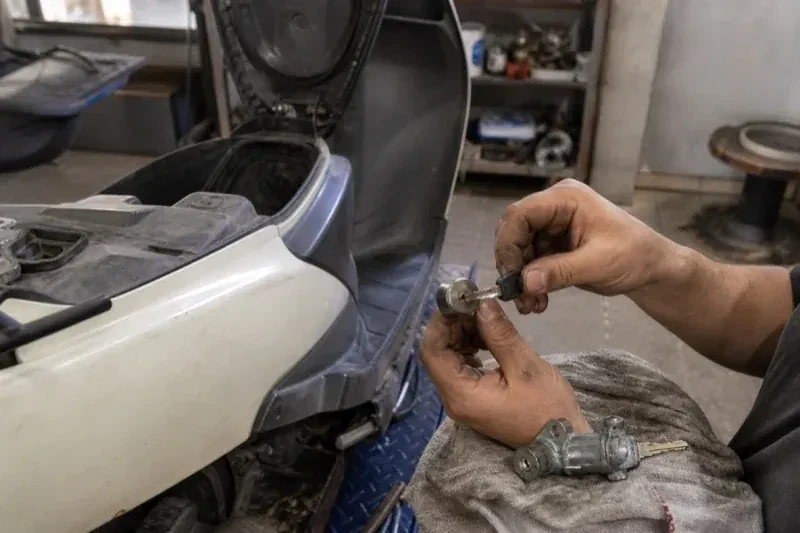
Sometimes the machine is not the problem; the key is. A blade that has worn thin, bent slightly, or been copied one generation too many stops lifting the wafers cleanly, which shows up as a key that needs a wiggle or a lift to turn. Rather than living with an unreliable copy, a fresh key cut directly from the lock's code or read from the original wafers restores a clean, consistent turn, and the worn key can be retired instead of carried as a backup that may not work when needed.
How the visit goesThe key still opens the seat and unlocks the fork, but at the ignition it needs a slow half-turn and a small lift before the switch engages, a habit that has crept in over years of daily starts.
Haldimand County
How the visit goes
Checking for an immobiliser
Many machines built in roughly the last two decades carry an electronic layer alongside the mechanical lock: a small chip inside the key that the ignition module checks before allowing the engine to run. The locksmith looks for a coil or ring around the ignition barrel, checks whether the dash shows a security alert with the current key, and asks whether the engine cranks without starting, which can point to a chip that is missing, damaged or unpaired, though ordinary fuel, ignition and compression faults produce the same symptom and are checked too. This decides whether the job is a straightforward cut or one that also needs transponder programming.
Pairing a new transponder
A machine with an immobiliser needs its electronics satisfied as well as its lock. Using either a remaining working key or programming equipment built for that system, the locksmith teaches the vehicle's module the new transponder's code where that system supports it, though some manufacturers require their own code key and a dealer procedure instead. The mechanical cut and the electronic pairing are separate steps and both have to succeed: a key can be shaped correctly and still fail to start the engine if the chip inside it was never taught to the machine, which is why this step is tested with a full engine start rather than just a turn of the switch.
A record worth keeping
A short written note of what was done, whether the lock was cut from an existing key, decoded from scratch, or paired as a new transponder, is worth keeping with the machine's other paperwork. It answers a question that often comes up later: whether a particular key is original or a replacement, and whether other locks on the bike were brought onto the same cut. For a machine that changes hands again down the road, that note saves the next owner from starting the same process from a single worn key and no history.
Motorcycle & Scooter Keys
In the van
- Torx and security bits
- Contact cleaner
- Transponder programming unit
- Wafer lock decoder
- Pick and tension tools
What affects the quote
Same fees day, night or weekend
1Whether a working key already exists
Whether a working key still exists changes the job considerably: cutting or duplicating from one is the more direct route, while decoding a lock with nothing to reference takes longer and shapes the time reflected in the total.
2Bringing multiple locks onto one key
Bringing the seat, fuel cap or a storage lock onto the ignition's key is extra work per lock rekeyed, separate from cutting the key itself, and is priced as its own line.
3Transponder and fob hardware
A transponder key needs a chip and, on some systems, a fob shell in addition to the cut blade, and that hardware is a separate line from a plain mechanical key.
Motorcycle & Scooter Keys: questions
Do I have to have the original key for you to cut a new one?
No. When every key for the machine is gone, the locksmith reads the lock directly, working out each wafer's depth by picking and reading the cylinder or using a decoder built for that keyway, and cuts a fresh key to the code that comes out of that reading. It takes longer than copying an existing key, since every wafer is read individually, but it produces a key that matches the lock rather than a guess.
Can a rusted or gritty lock still be opened and given a new key?
In most cases, yes. The lock is cleaned out, its wafers and springs cleared of grit and corrosion, and the mechanism dressed with whatever lubricant its own maker specifies before a new key is cut or tested. Only a lock that has corroded to the point of cracking or seizing solid tends to need outright replacement rather than cleaning, and that is usually visible once the lock is opened up for inspection.
What is a good way to keep a spare key safe?
Somewhere away from the machine itself is the main principle: not under the seat, in a saddlebag, or taped inside a compartment, since those are the first places anyone checks. A drawer at home, a family member's keyring, or a small lockbox mounted separately all work. Testing the spare on the actual lock before relying on it confirms it will do the job the one time it is needed.
Car Keys
- Car Key ReplacementYou bought the car privately and it came with a single key on a shoelace.
- Spare Car Key DuplicationThe blade on the everyday key has gone shiny and thin along one edge, and lately it needs a wiggle…
- Key Fob ProgrammingThe remote clicks the way it always has, but the vehicle no longer locks, unlocks or answers with…
Motorcycle & Scooter Keys near you
Below, each lock and key service we offer in Haldimand County gets its own page, with a description that assumes no prior knowledge. Start anywhere. Many customers arrive for a lockout and leave knowing exactly why the strike plate on the back door has bothered them for years.